
Feedback on BMW Scanner 1.4.0
- Thread starter jarance
- Start date
-
Click here to become an Official Member of BMW Club Malaysia Download Form
You are using an out of date browser. It may not display this or other websites correctly.
You should upgrade or use an alternative browser.
You should upgrade or use an alternative browser.

aidilj
Official Member
- Joined
- Jul 3, 2010
- Messages
- 2,291
- Points
- 0
moots;634116 said:wow....can we really do this......?perhaps the stories that we have heard about dealers adjusting the mileage is true?
I wouldn't be surprised, I think mine has been tampered with. Using the scanner 1.4 demo program which supports my KKL interface, I found a huge discrepancy between IKE and LCM mileage.. doesn't e46 have the tamper dot like e39?
aidilj
Official Member
- Joined
- Jul 3, 2010
- Messages
- 2,291
- Points
- 0
okay so a question, since I just found that e46 does have the tamper dot why doesn't my cluster have the dot when IKE and LCM mileage varies a lot?
my cluster

cluster with tamper dot

http://forums.bimmerforums.com/forum/showpost.php?p=21004341&postcount=7
my cluster
cluster with tamper dot
http://forums.bimmerforums.com/forum/showpost.php?p=21004341&postcount=7
aidilj
Official Member
- Joined
- Jul 3, 2010
- Messages
- 2,291
- Points
- 0
xcrave;634143 said:mine dont have it either... since it have a difference of 20K plus... i wonder? maybe they change something in the cluster bro?
From the link it seems that working around this problem is a lot of work but not impossible. I was just thinking that the difference is normal and the mileage was not tampered with even.. somebody with experience please chime in..

haywire
Official Member
- Joined
- Mar 15, 2009
- Messages
- 4,189
- Points
- 63
aidilj;634146 said:From the link it seems that working around this problem is a lot of work but not impossible. I was just thinking that the difference is normal and the mileage was not tampered with even.. somebody with experience please chime in..
One simple but harsh way to do it is open up the cluster and taking out the tamper dot LED entirely. Seen some cases of these in the UK.
aidilj
Official Member
- Joined
- Jul 3, 2010
- Messages
- 2,291
- Points
- 0
haywire;634148 said:One simple but harsh way to do it is open up the cluster and taking out the tamper dot LED entirely. Seen some cases of these in the UK.
Yup saw some reply like that but on e46 it is displayed on the LCD


Herbert
Well-Known Member
- Joined
- Sep 8, 2009
- Messages
- 4,443
- Points
- 83
Jarance,
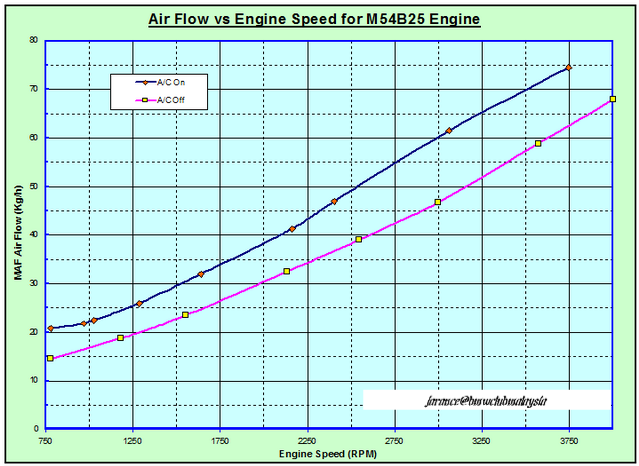
Thanks for your above chart which is informative. Wonder whether you can search the net to confirm your chart? MAF is out of stock now and accordling to Bavarian Auto, new stock will be in this Friday. Will get a new MAF and plot my chart.
Thanks for your above chart which is informative. Wonder whether you can search the net to confirm your chart? MAF is out of stock now and accordling to Bavarian Auto, new stock will be in this Friday. Will get a new MAF and plot my chart.
herbert;634577 said:Jarance,
Thanks for your above chart which is informative. Wonder whether you can search the net to confirm your chart? MAF is out of stock now and accordling to Bavarian Auto, new stock will be in this Friday. Will get a new MAF and plot my chart.
I did try to google for it but cant seem to find it. Would appreciate if can counter-check with a new MAF.
BTW, a bit difficult to get the exact rpm with a stick and the electric seat.. but at least the speed can be maintained.

Alex5522
Club Guest
- Joined
- May 28, 2010
- Messages
- 2,324
- Points
- 38
jarance;634587 said:I did try to google for it but cant seem to find it. Would appreciate if can counter-check with a new MAF.
BTW, a bit difficult to get the exact rpm with a stick and the electric seat.. but at least the speed can be maintained.
Bro do u think this way will do ? Jack up the whole body of the car then run with auto cruise and set with your desire rpm.
Alex5522;634600 said:Bro do u think this way will do ? Jack up the whole body of the car then run with auto cruise and set with your desire rpm.
bro, it wont work lah cos the GB module will change gear and maintain optimum RPM.
furthermore, result would be different cos there is a load.
The test is for free running i.e. no load test.

IanDaddy
Club Guest
- Joined
- Sep 29, 2009
- Messages
- 528
- Points
- 18
Jarance, you really did it. From the graph, you MAF looks OK.
Herbert, from the catalogue of siemens-vdo, E46/E39 with M54 and HYUNDAI SONATA 2.5 2000 (not sure this is available locally).
Many in US have used the Hyundai MAF with no problem at less than half the price.
Herbert, from the catalogue of siemens-vdo, E46/E39 with M54 and HYUNDAI SONATA 2.5 2000 (not sure this is available locally).
Many in US have used the Hyundai MAF with no problem at less than half the price.
Herbert
Well-Known Member
- Joined
- Sep 8, 2009
- Messages
- 4,443
- Points
- 83
IanDaddy;634833 said:Jarance, you really did it. From the graph, you MAF looks OK.
Herbert, from the catalogue of siemens-vdo, E46/E39 with M54 and HYUNDAI SONATA 2.5 2000 (not sure this is available locally).
Many in US have used the Hyundai MAF with no problem at less than half the price.
IanDaddy,
Thanks for your info. I have checked with BA & Bomin on MAF for e39. Original BMW MAF is about RM2k+ whereas OEM from Siemens-VDO is RM600.00. What do you mean by at less than half the price? (of original or OEM?).
With regards to Jarance's MAF chart/graph, can you share your thoughts as to why his MAF looks OK? From what I understand (hearsay from my mechanic), a good/new MAF value should be 11 kgm/hr (aircon OFF) and 15 kgm/hr (aircon ON). You also posted your MAF live data similar to these figures. However your fuel consumption of 13L/100km is high due likely due to degrade pre-cat 02 sensors.

xcrave
Club Guest
- Joined
- Nov 16, 2010
- Messages
- 720
- Points
- 0
Just a thought... do you guys actually considered Air filter? Ive changed mine to K&N drop in... ive seen and felt much better response from my engine...
Maybe the MAF is not at fault... the air filter is blocking air to the engine (lean,rich) reading???
When cleaning the MAF sensor did you also clean the air screen too? BTW there is more than handful people out there who just ruined the MAF by doing the CRC MAF cleaning... hope this is not the case... as the saying goes, if its not broken dont fix it...
Just my 2 cents... but MAF reading should be ok like what have been said... unless you are comparing to an M3/M5 charts yeah urs is wayyy off...
Here are the reading i got from a forum friend **not a specialist or anything just direct from his own car reading**
Depending on the Engine CC/ltrs/Etc based on his E46 323i 2.2K++ cc his MAF have the Approx of 11.36 - 11.47 kgm/hr at idle and with AC it should not be not more than 16 kg/hr (he's is 14.65 - 15.2 kgm/hr) or its a sign of failing MAF. Resulting to shudders and stalls... loss of power is the most obvious sign
Im not sure myself just sharing when i show him Jarance graph he said its neither bad or good... could be bad he said, then again hes also not a specialist... so yeah show to specialist better than guessing... beat the forum purpose tho but at least it will not be so much confusion as there are already is...
Maybe the MAF is not at fault... the air filter is blocking air to the engine (lean,rich) reading???
When cleaning the MAF sensor did you also clean the air screen too? BTW there is more than handful people out there who just ruined the MAF by doing the CRC MAF cleaning... hope this is not the case... as the saying goes, if its not broken dont fix it...
Just my 2 cents... but MAF reading should be ok like what have been said... unless you are comparing to an M3/M5 charts yeah urs is wayyy off...
Here are the reading i got from a forum friend **not a specialist or anything just direct from his own car reading**
Depending on the Engine CC/ltrs/Etc based on his E46 323i 2.2K++ cc his MAF have the Approx of 11.36 - 11.47 kgm/hr at idle and with AC it should not be not more than 16 kg/hr (he's is 14.65 - 15.2 kgm/hr) or its a sign of failing MAF. Resulting to shudders and stalls... loss of power is the most obvious sign
Im not sure myself just sharing when i show him Jarance graph he said its neither bad or good... could be bad he said, then again hes also not a specialist... so yeah show to specialist better than guessing... beat the forum purpose tho but at least it will not be so much confusion as there are already is...
IanDaddy
Club Guest
- Joined
- Sep 29, 2009
- Messages
- 528
- Points
- 18
Herbert, the OEM Hyundai part in US retail around 150 USD (on ebay) while the OEM part for BMW is more than 300USD.
I think Jarance's graph look ok because the linear increase of the air mass vs RPM (constant load in this case). I think our MAF is hot-wire type where the wire is heated to some 300 degrees F, when air passes through and cools the wire the MAF will attempt to keep the wire at that same temp, the amount of current needed to keep the temp is proportional to the air mass entering the throttle body. That is why when the MAF is dirty the cooling is not so consistent. Not sure about BMW MAF, most hot-wire MAF will heat the wire to a very high temp for a short while to burn off the contaminants when turn off the engine.
My FC is not that good because more than 70% City use. I can get less than 10L/100KM for highway at cruising speed. I have done many things, vanos seals, check the DISA, check leaks, and I will clean out the vanos solenoids and the little piston/valve soon. I always suspect the O2 sensors are sluggish, because I feel sluggish O2 sensors will affect the most stop/go and city type of driving where RPM/speed keep flunctuating. The O2 sensors voltage should flunctuate at about .45 volt at fast as possible so air/fuel mixture can be optimized. All these are based on my limited research. I am still trying to use GT1 or other software to see the frequencies of the O2 sensors, before I change them out.
I have read that some have tried driving with MAF disconnected, if it car perform better with MAF disconnected then the MAF is bad. I think the logic here is that , the DME will operate in open-loop with preloaded map when the MAF is disconnected so the performance should be better.
These are strictly my opinion.
I think Jarance's graph look ok because the linear increase of the air mass vs RPM (constant load in this case). I think our MAF is hot-wire type where the wire is heated to some 300 degrees F, when air passes through and cools the wire the MAF will attempt to keep the wire at that same temp, the amount of current needed to keep the temp is proportional to the air mass entering the throttle body. That is why when the MAF is dirty the cooling is not so consistent. Not sure about BMW MAF, most hot-wire MAF will heat the wire to a very high temp for a short while to burn off the contaminants when turn off the engine.
My FC is not that good because more than 70% City use. I can get less than 10L/100KM for highway at cruising speed. I have done many things, vanos seals, check the DISA, check leaks, and I will clean out the vanos solenoids and the little piston/valve soon. I always suspect the O2 sensors are sluggish, because I feel sluggish O2 sensors will affect the most stop/go and city type of driving where RPM/speed keep flunctuating. The O2 sensors voltage should flunctuate at about .45 volt at fast as possible so air/fuel mixture can be optimized. All these are based on my limited research. I am still trying to use GT1 or other software to see the frequencies of the O2 sensors, before I change them out.
I have read that some have tried driving with MAF disconnected, if it car perform better with MAF disconnected then the MAF is bad. I think the logic here is that , the DME will operate in open-loop with preloaded map when the MAF is disconnected so the performance should be better.
These are strictly my opinion.
xcrave
Club Guest
- Joined
- Nov 16, 2010
- Messages
- 720
- Points
- 0
hky;634903 said:xcrave,
I heard about the CRC ruining the MAF too, but how true is that, i have also heard the K&N filter oil also can ruin the MAF, due to the oily substance from the K&N filter. ????
K&N oily substance due to the user excessive application, especially during DIY servicing (until the oil actually DRIPS!!!) yes thats a possibility... but mind you K&N are used on M3 / M5 cars and its even those performance type (the one without any covers). So i guess particle/contaminants passing through the K&N filter are even lesser compared to the stock paper type...
I would have taken the picture of my 1 year old filter with sand and dust that even you cant imagine, compared to the oil that the K&N filter might do to the engine... but ive discarded it with much hate that i actually tear it apart to just see how good it was... sadly it does nothing but block the air contamination and soon clog up the air intake.
The stock filter are doing nothing to sands and dust it simply block them then in turn letting them get sucked in through tiny holes from your filtration system after a while... my air intake box was full with sand and debris and its only been a few months after changing them... i have to wash them out last time before using K&N... most of user depends on Online one sided review which in turn effect their ability to decide. Ive seen another 5 series UDM (my uncle's) using K&N for 2 years now... he said there is never a problem with his MAF and engine was shockingly clean compared to his previous top overhaul...
i do not work with K&N and this is by far not even related to selling K&N filter...

I think it all boils down to one thing, either use it or dont it does give slight to no increase in HP or performance but it does traps all the dust from the air rather than let it fly everywhere freely... im due to service my car soon in a few months i'll keep in mind to take picture of the service washing and dust in my air intake for all to judge
On a side note: my FC went up from 6.6 to 7.4l/100KM so hurmmm maybe the filters maybe ive just been driving like a saint
Herbert
Well-Known Member
- Joined
- Sep 8, 2009
- Messages
- 4,443
- Points
- 83
IanDaddy & Xcrave
Thanks for all your explanation and suggestions. I have also read many comments from other overseas BMW forums plus articles on MAF written by OEM manufacturers. There are many school of thoughts on MAF and sometimes it is really confusing. My ride is running smoothly as I have over the 24 months replaced many items including a re-map. Amongst the few items I did not replace is the MAF sensor and henceforth the urge to replace it with a new one. BA told me the new MAF stock should be avaliable end of this week.
Thanks for all your explanation and suggestions. I have also read many comments from other overseas BMW forums plus articles on MAF written by OEM manufacturers. There are many school of thoughts on MAF and sometimes it is really confusing. My ride is running smoothly as I have over the 24 months replaced many items including a re-map. Amongst the few items I did not replace is the MAF sensor and henceforth the urge to replace it with a new one. BA told me the new MAF stock should be avaliable end of this week.
Similar threads


- Replies
- 257
- Views
- 27K

- Replies
- 39
- Views
- 34K


- Replies
- 7
- Views
- 2K

- Replies
- 8
- Views
- 13K


- Replies
- 2
- Views
- 4K